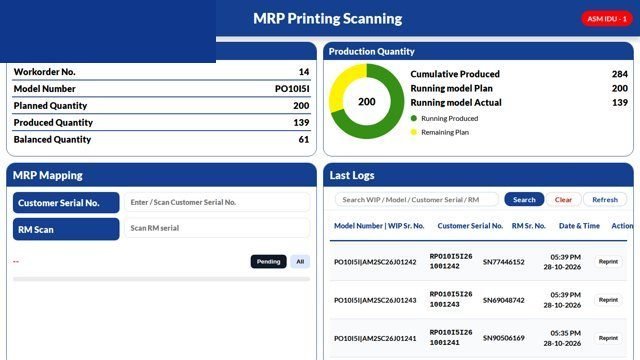
Every unit scanned at every station. Nothing skips a stage.

Each unit carries a serial. At every station MOS checks that the unit passed every stage before it, that the parts fitted match the bill of materials, and that the test results are within limits — and only then lets the line move on. Labels print at the right station, quality holds stop a batch on the spot, and every unit keeps its full history from first station to the truck.
Paper travellers and separate test-bench files let a unit miss a stage and still ship. The record exists — in five places that never meet.
“MOS scans the unit at every station, checks it passed every stage before, that the right parts were fitted, and reads the test results from the benches — then lets it move on, or holds it.”
Drawn, not promised: the top row is a unit walking past a test that nobody notices until dispatch — or the customer. The bottom row is the same unit refused by the next station until the stage before it is on record.
Hover or tap a stage to see what is captured there.
Not a standalone tool — a product on the MOS platform, sharing one login, one set of people and roles, and one database with every other module. The lit layers are the ones this product uses; the signal path shows how data moves through them.
The honest map, drawn as one thread. Filled nodes are in the product today; outlined nodes are other MOS modules on the same platform; dotted nodes are roadmap and never represented as available until built. Hover a node.
Each card ends with the thing itself as it appears in MOS — not a description of it.
Step through it or let it play. Each step: who does it, on what, what is captured, and the check that guards it.
Stations, their order, the parts fitted at each and the tests each must pass are set up once per model.
A work order for a model and quantity is released; every station gets the model's masters in seconds.
The unit serial is scanned; MOS checks it passed every earlier mandatory stage.
Serial-tracked parts are scanned and checked against the BOM — right part, not used before.
Leak, vacuum, hi-pot and run-test results are read from the bench, not typed.
A unit that passed gets its label and moves on; a failed one is refused with the reason.
A quality hold stops a batch at once; release is recorded with who and why.
Units leave against the sales order; the full genealogy stays searchable by serial.
| Your ERP / Tally typically gives | MES & Traceability adds |
|---|---|
| A paper traveller per unit | A scan at every station, interlocked |
| Test results in bench files | Results read from the bench onto the serial |
| BOM assumed | BOM serials checked at the station |
| Recall by date range | Genealogy searchable by serial |
A scanner and a screen or tablet per station
Read over Modbus or from the bench's own database
Label printers where labels are applied
MOS Edge in the plant; works if the link drops
What it connects to, where it runs and what it gives you — the short version your IT and your plant head both want.
Work orders, stage interlock, BOM checks, bench results, labels, hold/release, genealogy, matching.
MOS Face (operator verification) and MOS OEE on the same stations.
Each bench's protocol or database is connected at site.
Supplier-lot genealogy — not represented as available.
Capabilities depend on the plant's process and what is connected at site. Nothing on this page is represented as available until it is built and running.
A clear go / no-go at the station, with the reason
Holds, releases and every test result by serial
Output per station and hour, first-pass yield
Only released units, matched and labelled
A scanner, and a screen or tablet for the go / no-go.
The bench result read over its network or from its files.
The MOS plant server and label printers where labels are applied.
Stations, order, parts and tests set up with your team.
Stations scan and refuse units that skipped a stage.
Every unit traceable from first station to truck.
The station keeps its last state and the plant server runs locally; scans are queued and posted when the link returns.
Only a role you allow can release a held unit, and every release is recorded with who and why.
Every machine, live — and the real reason it stopped.
See the module →kWh per machine, per shift and per part — read from the meters, not the bill.
See the module →Every part judged by camera in under a second, defect circled.
See the module →Tell us about your plant and what you want to see. We visit, connect one machine or station, and you watch your own data in MOS before anything is quoted.